From your first word to N1 vocabulary.
One path through 7,879 words, in the order they're used, with the kanji inside them. Start from zero, or place yourself with a three-minute typed check. Hashidari keeps your place and brings every word back right before you'd forget it.
A free account takes your email and a code we send to it. No password. Not sure yet? Try one sample lesson first, no account needed.
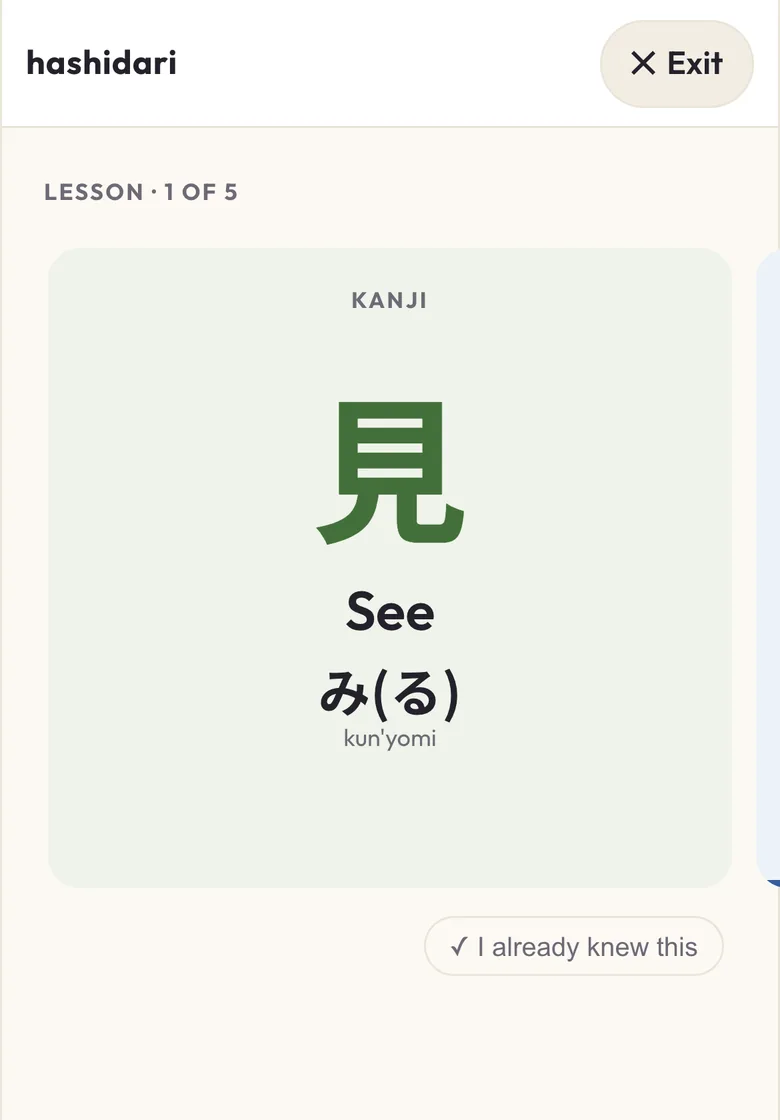
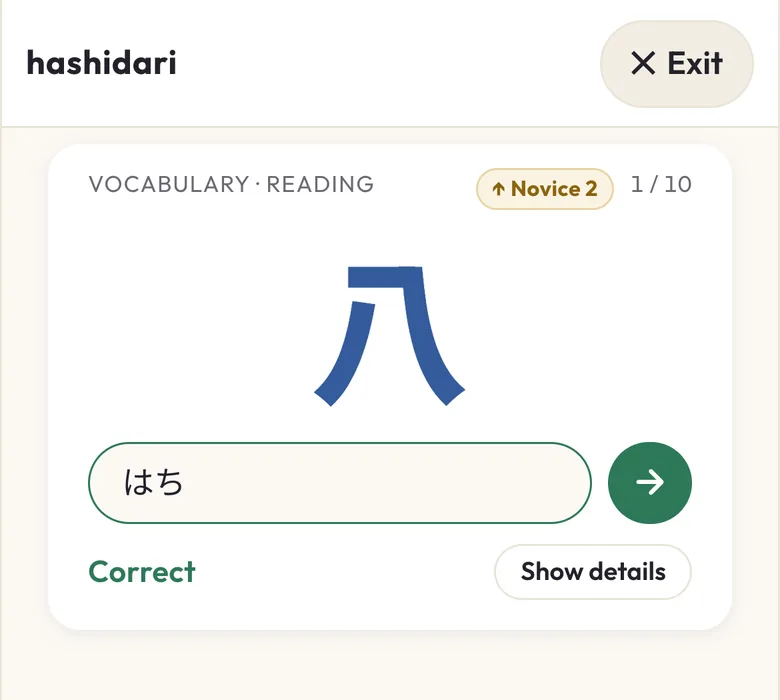
Useful Japanese, as fast as we can get you there.
That's the goal behind every part of Hashidari. You start from what you already know and move straight on to what's new, so every lesson goes to the words you're ready to learn next.
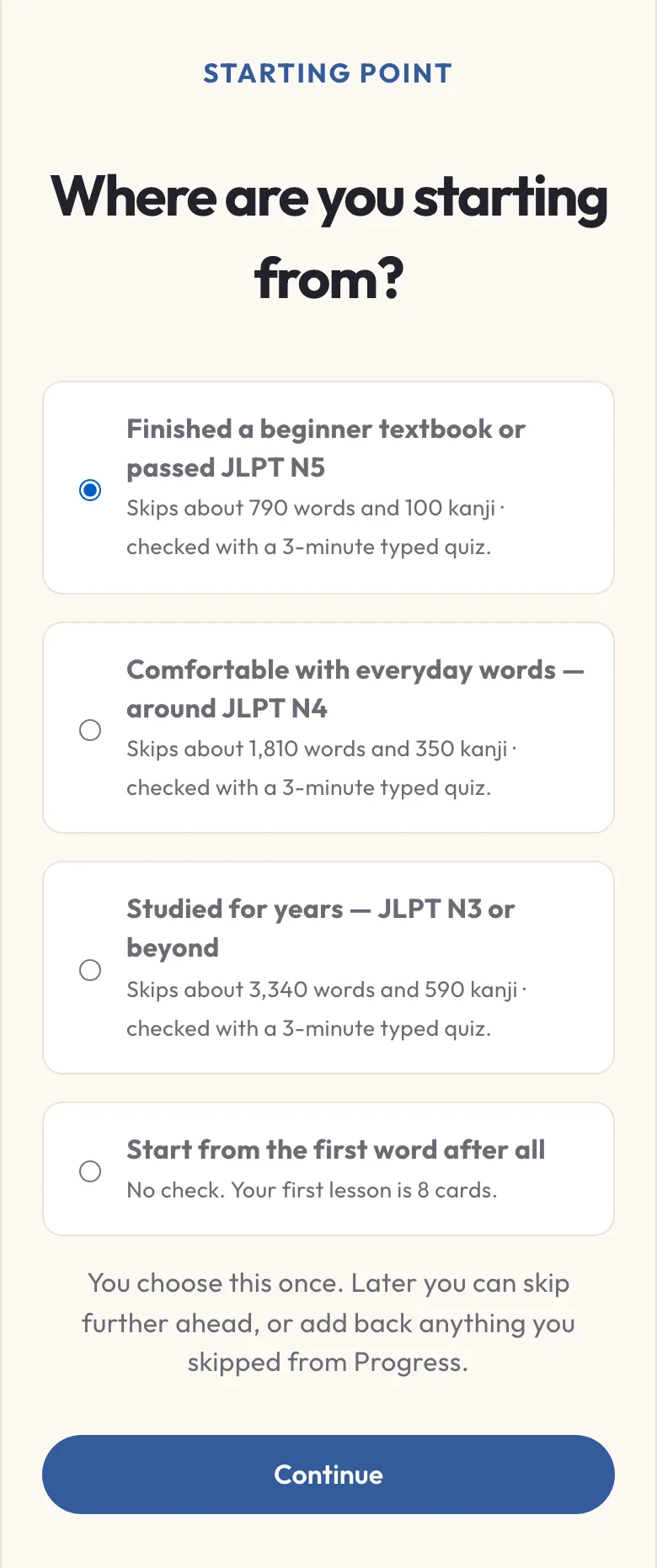
Start where you really are
Choose a starting point: fresh, finished a beginner textbook, around N4, or N3 and beyond. A short typed check, about three minutes, confirms it. If it's harder than you expected, a second check finds a better start instead of guessing.
You set it once, when you begin. After that it only moves forward: if lessons feel too easy, a short typed check skips the next block. Anything a check skipped is listed on your Progress page, where you can add any single item back to your lessons.
Skip any card you already know
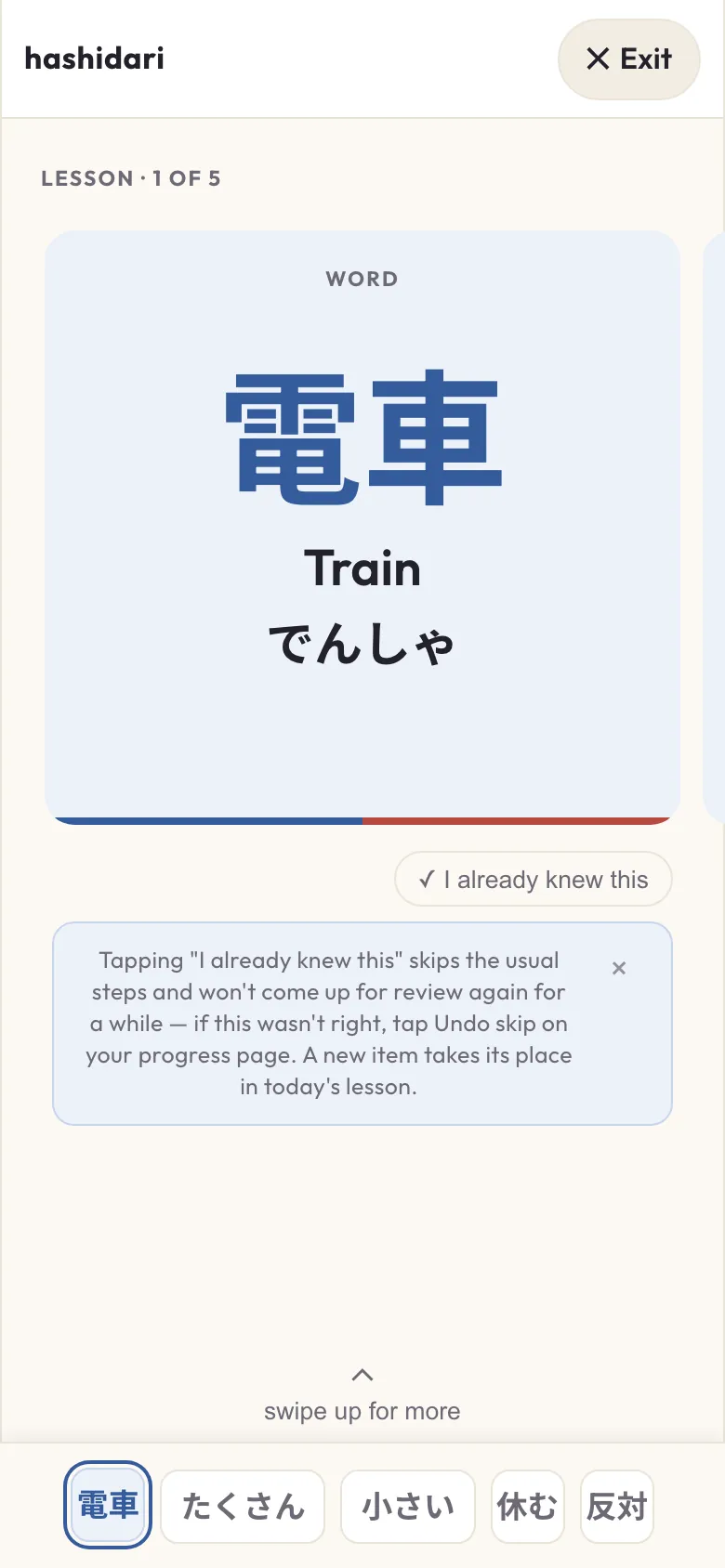
Know this one already? Tap “I already knew this” and a new word takes its place in today's lesson, so words you know never use up your lessons. Up to 100 skips a day. Tapped it by mistake? Undo skip on your Progress page brings the word back.
Skipping cards is part of Plus, and included in the 14-day free trial.
Learn what's next. Keep what you learn.
Common words first, kanji as you need them
The path follows how often words are actually used, not textbook chapters. Some everyday words arrive before their kanji: you learn them whole, reading printed, and the kanji catch up. Every kanji comes after the parts it's built from.
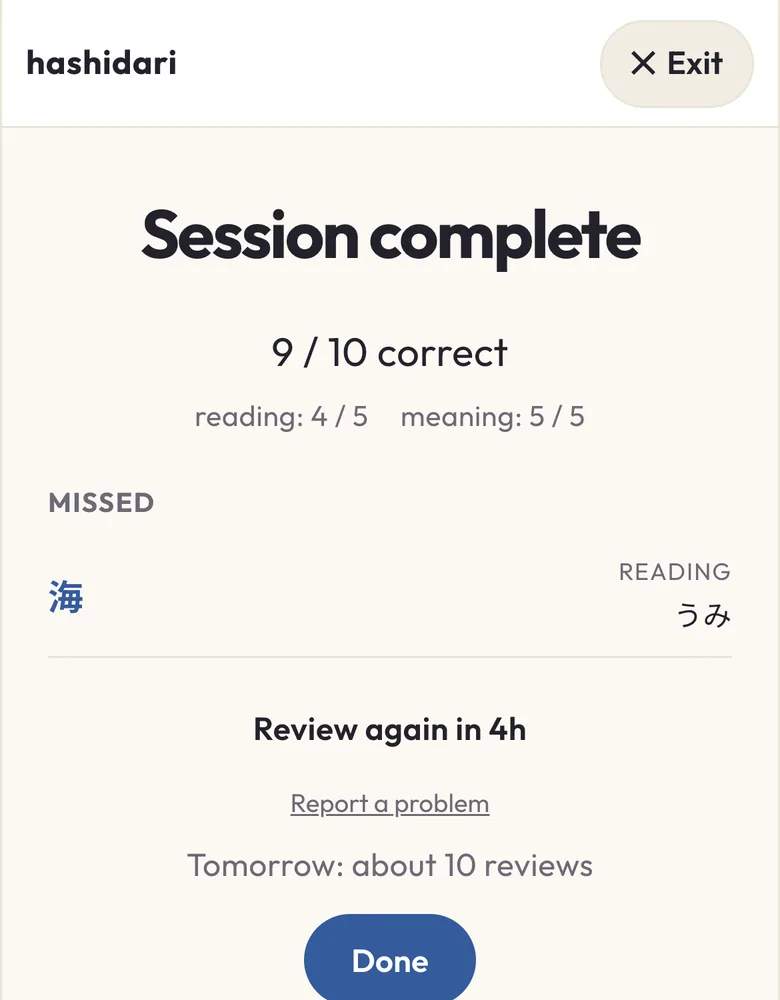
Type it back, on schedule
Meaning in English, reading in kana, typed, never multiple choice. Each item comes back after 4 hours, then further out every time you're right, up to four months. Misses come back sooner.
The whole road, in order.
Most words carry a JLPT tag from N5 to N1. The tags come from a community reconstruction of the lists, because the JLPT hasn't published official ones since 2010. About seven in ten words come with a real example sentence, and all 2,136 Jōyō kanji and 208 radicals are there to look up.
Inside a lesson. Inside a review.
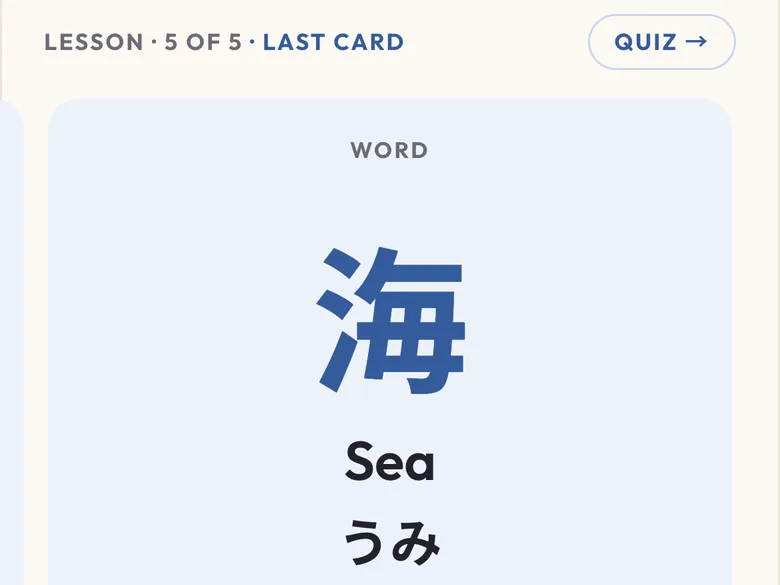
Five cards at a time
A lesson is five cards (ten on Plus). Swipe through them, pull any card up for its full write-up, and on Plus, skip the ones you already know.
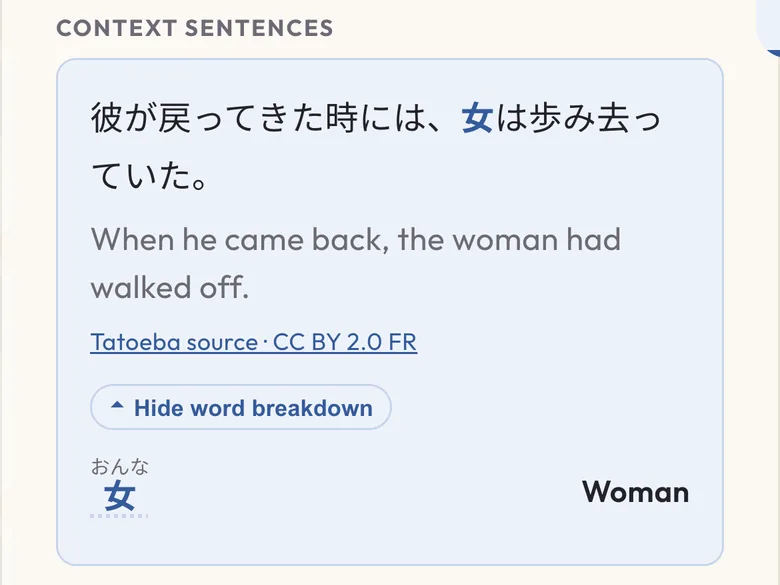
Real sentences, broken down
About seven in ten words come with a sentence from Tatoeba, translated, with a tap-to-open word-by-word breakdown. Up to three per word.
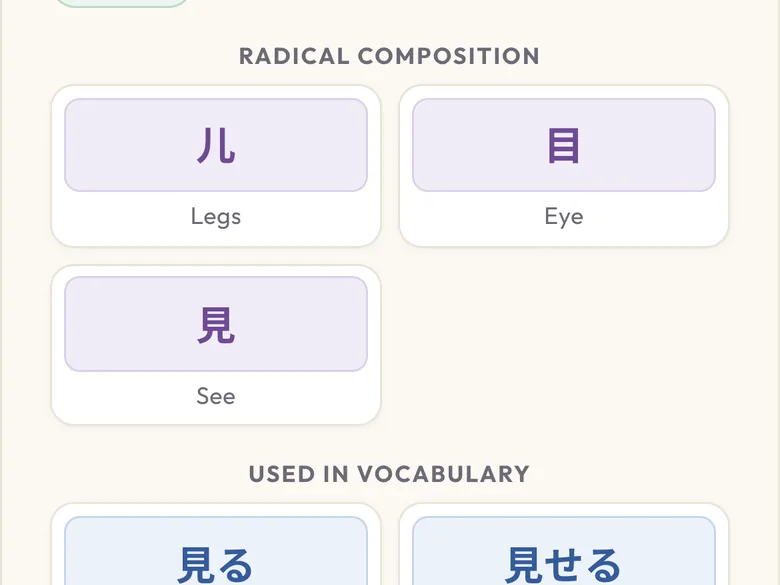
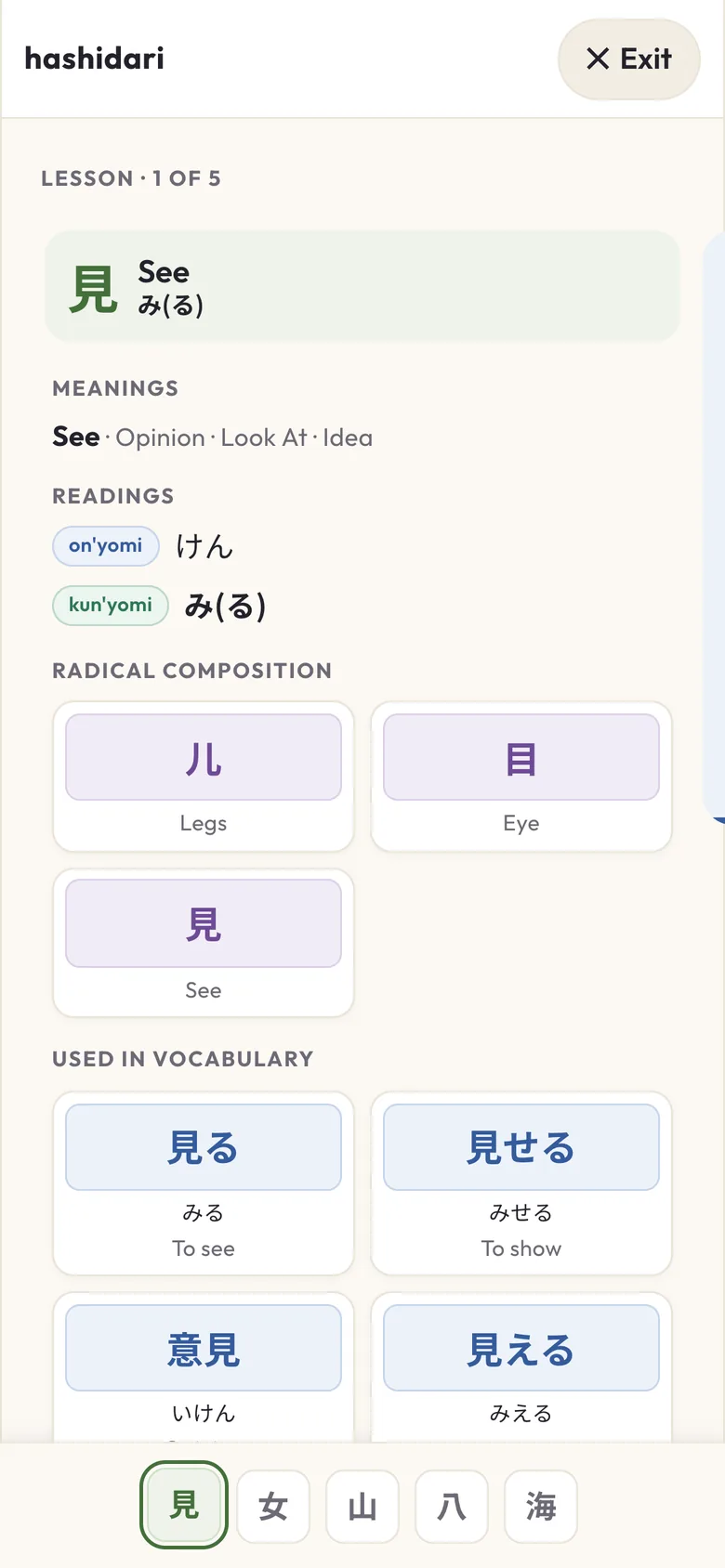
Every kanji, taken apart
Each kanji shows the radicals it's built from and the words that use it, with on and kun readings. No mnemonics, no invented radical names.
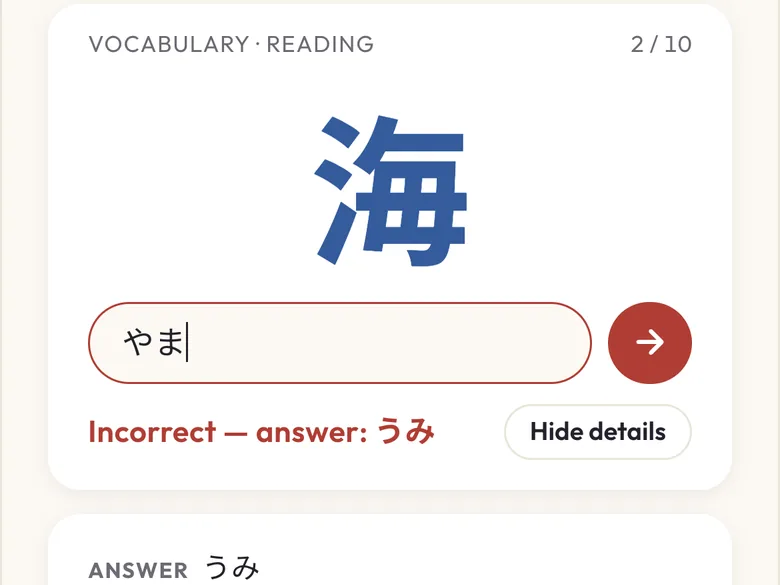
Miss one, learn it right there
A wrong answer opens the answer, what you typed, and the full write-up without leaving the card. A wrong reading gets one more try before it counts.
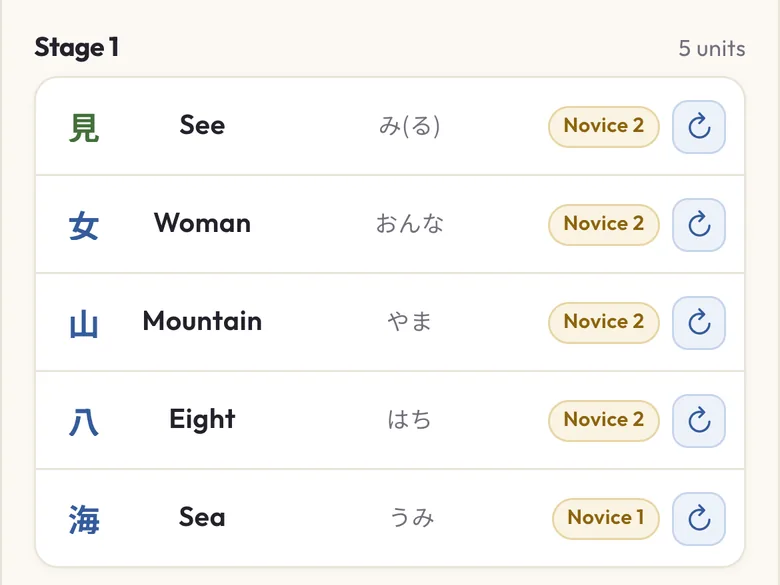
See where every word stands
Every item you've learned, grouped by stage, with its review level. One tap brings anything back as a review in about four hours.
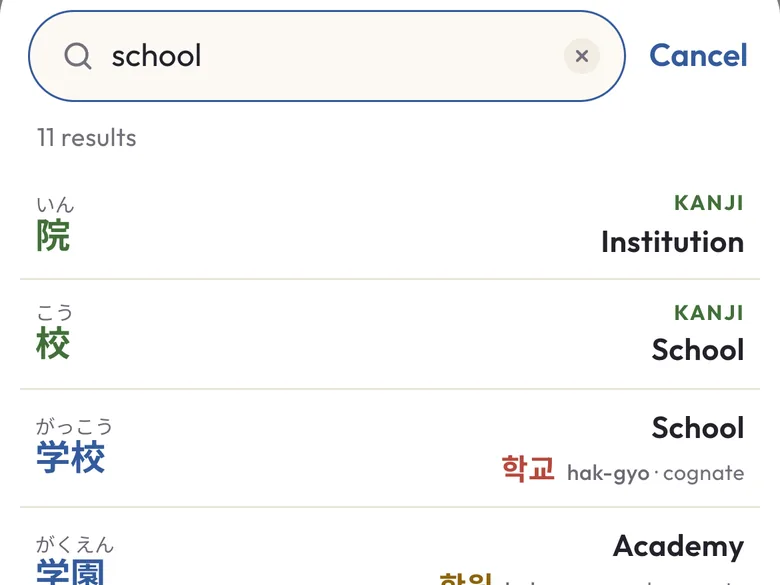
A dictionary you can search
Search by English, kana or kanji across every word, kanji and radical. ⌘K on a keyboard. Each result opens its full page.
Readings, meanings and decompositions come from KANJIDIC2 and KRADFILE; words and senses from JMdict; Japanese sentences from Tatoeba; Korean sentences from the National Institute of Korean Language's Basic Korean Dictionary; JLPT tags from tanos.co.uk; lesson order from wordfreq and Tatoeba word frequencies. Every source is licensed and listed. No mnemonics, no invented radical names.
The Korean bridge, if you want it.
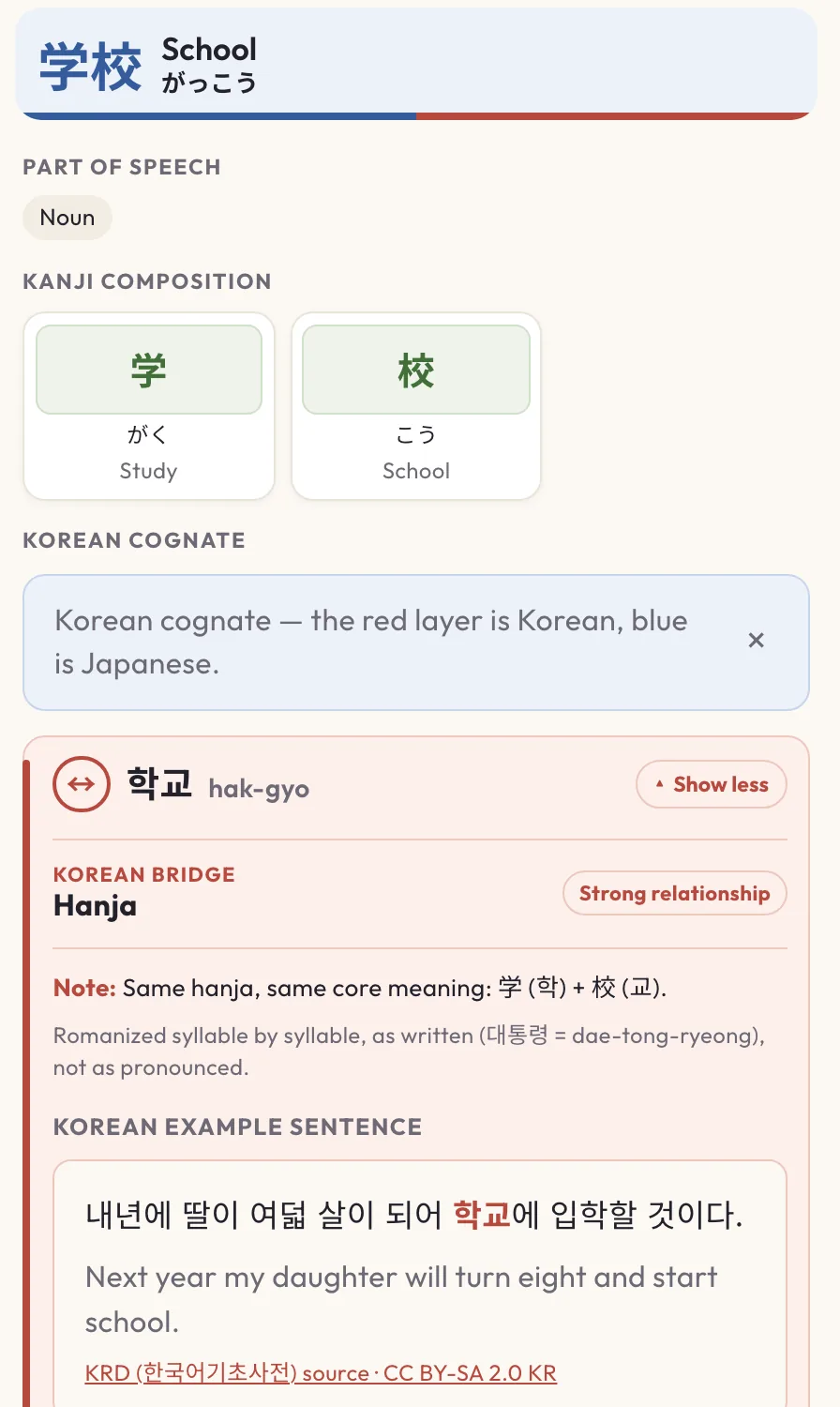
More than half of the words in Hashidari have a Korean cognate: 학교 → 学校, 선생 → 先生. Each one sits right under the Japanese, marked strong or weak, and the false friends are flagged. Cognates are shown, never graded, unless you ask to be tested. Turn on Korean practice and, once you know a word's Japanese, you'll be asked for its Korean too. Turn the bridge off and nothing about the Japanese path changes.
Free to start. Yours to keep.
Your trial starts where you do
Placed past the beginner lessons? Your 14 days of Plus start right there, so you never have to redo what you know to find out if it's worth it. No card. It begins only when you tap to continue.
What you learn stays yours
After the trial, reviews of everything you've learned stay free, forever, and so do the first lessons. Plus continues the path from exactly where you are for $6 a month or $60 a year, tax included. Subscribe during your trial and nothing is charged until it ends.
Questions
Will this get me through N1?
It covers N1-level vocabulary and the kanji inside it. It doesn't teach grammar, listening or reading practice yet, so pair it with a grammar resource for the exam.
I've studied before. Do I start over?
No. When you start, pick your level and take a typed check of about three minutes. It only moves your starting point. After that, your start only moves forward: a short check skips the next block of lessons if they feel too easy. On Plus or the free trial, you can also skip any single card with "I already knew this".
What's the order based on?
Mostly how often words are used, grouped into six stages from survival Japanese to specialized and literary. It isn't any textbook's chapter order.
Do I need to know Korean?
No. The Korean bridge is extra help for people who read Hangul. Without it, Hashidari is a complete Japanese kanji and vocabulary course.
Can I trust the cognates?
Every pair was reviewed before it shipped. Each one is marked strong or weak, and false friends are flagged. They're hints, and you're never graded on them unless you turn on Korean practice.
Do I need an account?
Yes, a free one. You log in with a code we email you, no password. Want to look first? One sample lesson runs in your browser without an account. The free account opens the free beginner stages, placement, and the 14-day Plus trial, and keeps your progress in sync across your devices.
Does it work offline?
Yes. Reviews need no signal, and each day's lessons download in one go when you start the first one.
Is there an app?
Hashidari is a web app. Add it to your home screen from the browser and it opens full-screen like any app, follows your phone's dark mode, and updates itself. Nothing to install from a store.
What happens after the trial?
Your reviews keep coming, free, for everything you've learned, and your place on the path is kept. Plus continues your lessons from exactly where you stopped.
Why "Hashidari"?
Hashi (橋) means "bridge" in Japanese, and dari (다리) means "bridge" in Korean. Hashidari is a bridge between the two languages, built for learners who want to cross into Japanese.
No testimonials yet. Here's what you can check instead.
Every screenshot on this page is the real app. Every source is named, and every number on this page is counted from the app's own content. The sample lesson doesn't ask for your email. The free account does.
Try a sample lesson